Vishakha
Desai:
Good evening and welcome to the Asia Society. It’s really
a great pleasure to see all of you here this evening. I should
say that it was almost ten years ago to the day that we organized
our first roundtable on contemporary Asian art. That moment was
one of those moments when you almost feel like, “My God!
I wonder where we will go from here?” Little would we have
thought that we would be here today with as many of you interested
in contemporary Asian art. It’s a great honour for me to
introduce two friends and colleagues, both of them truly stars
in their own right. Apinan Poshyananda is an artist and an art
historian, one of the most distinguished curators in contemporary
Asian art, who has been involved with more exhibitions of contemporary
Asian art across the globe than almost anyone else. He has been
a commissioner of biennales and triennales whether you go to Japan,
or Argentina or Brazil. He was a commissioner for the Asian section
of the Sao Paulo Biennale. He is a scholar and he’s also
a prolific writer. He received his Ph.D. from Cornell University
and in fact it was soon after he received his Ph.D. and went back
to Bangkok is when I had the opportunity to meet him in 1991.
He was a member of the first roundtable exactly a decade ago.
He was also a curator of our own highly acclaimed Traditions/Tensions
exhibition and he will be curating our upcoming exhibition on
Montien Boonma, one of the very fine Thai artists who unfortunately
passed away. Apinan is going to be joined with Okwui Enwezor.
I think it’s very hard to introduce Okwui because he truly
has become an international star. As some of you know, it was
more than twenty years ago when he came to this country. It was
not to study art. It was to study political science. While Okwui
was studying political science, he started writing poetry and
art criticism. As he started writing about art, soon it had to
do with being around art and before you knew it, it was to really
begin to organize exhibitions. He was, in fact, the art director
of the Second Johannesburg Biennale and he has been involved in
a number of other exhibitions. The one in New York you might be
aware of is Global Conceptualism in which he was the co-curator
for the African section. He has also been a founder and one of
the editors of one of the most distinguished African art journals
that began in the 1990s. Of course, he is most well-known for
being the art director of Documenta XI, the last Documenta. As
a number of art critics have said, Documenta is to contemporary
art what Olympics are to the world of sports. So please join me
in welcoming Apinan Poshyananda and Okwui Enwezor.
Vishakha Desai:
These two told me that one of them was going to come in a wheelchair.
It has to do with whether curators are actually challenged people,
because they travel so much, both of them. I thought I would start
with the beginning of the awareness of contemporary art because
you really can’t talk about it as the beginning because
as we all know, the contemporary art world in the non-Euro-American
centres has been going on for a long time. So it’s really
only the beginning for the western art world, perhaps, in the
1990s. Both of you started more or less at that time and I wonder
if you might go back to that moment and talk a little bit about
what it was like then. How did it feel? Okwui, you were already
in New York then and Apinan, you had just gone back to Bangkok.
What was your perception? What was it like?
Okwui Enwezor:
Well, it’s rather difficult to go back to the beginning
because it means that by going back one has to leave a number
of things behind, in order to talk about the beginning. You know,
I think that for me the trajectory of coming to where I am today
as a curator really is not one straight path. It was many different
paths, many different attachments, multiple attachments if you
will, intellectually, culturally, politically and otherwise, and
so in a sense I come to where I am today with the idea of these
multiple attachments deeply entangled with each other, and informing
the sense that in order to think historically in the present,
that one in a sense has to begin from the process of unlearning
certain ideas that makes it quite burdensome to get into this
very incredibly heady space called the contemporary art world.
I come from Nigeria and I come from a place that has absolutely
no museums such as we find in New York. I don’t think many
people here would appreciate that, especially from the perspective
of what it means to think and to really look at art thoughtfully
in a way that allows the possibility for that art to have an impact
on the way you experience it. So I must really say that the 1990s
is not a beginning as it were. It is a beginning only in terms
of the way in which people’s trajectories are suddenly mapped,
you know, you arrive fully born, already fully formed and not
as an infant. So I might say that it is an art world I confronted,
I engaged with, looking with a sideways glance, looking with a
great sense of preservation, a great sense of, shall I say, frustration,
shall I say, envy, if you will, because I come from a place that
does not have a museum of modern art, that has no right in any
sense of the form to demand a critical space in those discourses
that one saw in all those different museums. What I saw was great
and also what I saw was a world that seemed to me to have a certain
type of historical amnesia. My work as a curator began right from
there. I mean, it was learning on the job but to learn one has
to really sort of come up with a makeshift toolkit, if you will.
You have to try whatever works in order to begin.
Vishakha Desai: Like guerrilla
warfare?
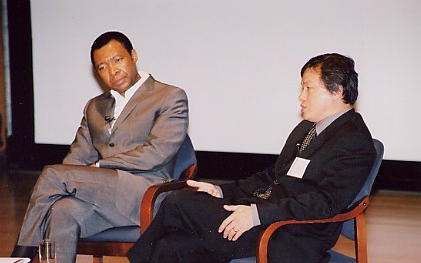
Okwui Enwezor:
Well, in a sense. I don’t quite see it as warfare in the
sense that I really had no sense I would end up being the curator
I am today. It was really just, you know, a matter of a very ad
hoc movement?I get to make a slight intervention on behalf of
my contemporaries, if you will. I had lived in the United States
since 1982 and I had worked in as many different kinds of jobs
you can imagine, you can say that I’m the quintessential
American story, if you will. The immigrant who comes and makes
it, in a sense. So this is for me the beginning, the beginning
of really thinking, reading, and I saw the world in a transversal
manner. I didn’t see the world in a straight, rigorous,
narrow manner. I saw the world in the context of the multiplicity
of perspectives that were right before me in New York, and that’s
where I started working.
Vishakha Desai:
Apinan, for you it’s about you really being in this part
of the world and
then going back.
Apinan Poshyananda:
Like Okwui, I think I have to do a fast rewind back more than
a decade because I was born in Bangkok?we do have one or two museums
in Thailand?but I left Bangkok when I was ten, was sent to England
to a prep school and forced to talk with a stiff upper lip. Then
I did my degree at Edinbourough University, a fine art degree
which was a mix between art history and fine arts. I did return
to Bangkok wanting to be an artist actually. At the age of twenty-eight,
I won three national awards at the National Exhibition of Art
and I thought my career was going to be an artist. Then, mistakenly,
I was given this fellowship to do a Ph.D. at Cornell and I spent
another five years there and I had to return to Bangkok because
I had to repay my university. That was 1990, you see. I met my
wife at Cornell, got married. I was going to be a civil servant,
a teacher, an artist, a little bit, then something happened because
this one curator came along. I didn’t really know what it
meant. I thought a curator was supposed to cure an artist, you
know? You know, massage the ego. I later found out it is vice-versa.
Anyway, I had a trial of curating at the National Art Gallery
in Bangkok with seven Thai artists in 1991. And the second exhibition
I curated was representing Thai artists at the Sydney Biennale.
Then I bumped into Vishakha Desai in Bangkok and my life changed.
It’s been a really great experience. During that time I
was working for the APT, the Asian Pacific Triennale in Brisbane
that was going to open in 1993. The conference we had, in fact
I was here almost ten years ago giving this similar speech, I
mean I was much younger then, but it was an experience?the roundtable
discussion, because it was so lively, so vibrant, and there was
a lot of expectation in terms of what was going to happen. During
the two days of meeting at the roundtable discussion, it was almost
like getting to know you but not quite. Almost this gap where
the testing the water was such that sometimes it went very lukewarm,
there were other times it went very hot. Because, you know, in
these early days, names, translation, ability to represent or
not represent the passwords such as local, global, were not clear.
Vishakha suggested that something could happen in terms of exhibitions
here in contemporary art. Here, ten years ago, I actually was
quite rude because I ended my speech saying to the Asia Society
it’s about time to show living art. It’s time for
art and Asian art to talk back and it talked back. Ten years since
then it has really talked back and I’m so pleased and so
proud of the Asian artists, the amount of leap?and I would call
it leapfrogging?that they have done.
Vishakha Desai:
I think that’s in a way what both of you are suggesting.
This notion that “beginning” is really something that
is just beginning here but it is as you said, something fully
arrived, kind of an adult, but people don’t always treat
you that way because of the historical amnesia. I wonder if you
could talk a little bit more about that notion of historical amnesia
that you refer to Okwui, and I think to some extent that idea
as if the art in other parts of the world hadn’t happened
until somebody else discovered it.
Okwui Enwezor:
Well, for me the most instructive experience coming to the United
States is first and foremost learning that I was a minority and
it really is, I think, something that transforms you but at the
same time in many ways remains disturbing, if you will. I’m
in an exhibition The Short Century which was here earlier this
year and want to say, picture this, that in 1945, more than three-quarters
of the world were colonized. I mean, this was not three hundred
years ago, this was in 1945. The sheer numbers of people, billions,
and to think that post-1945 that the idea of self-determination
was not just simply a question of politics. It was a question
of the affirmation of a sense of self-understanding that has clear
cultural, social and moral import. I think that coming to the
United States was the challenge that I met. I come from a post-colonial
world in which people like Chinua Achebe and many other people
were writing with such incredible force and clarity that their
work has also transformed what is known as literature in English.
And why
is that possible and not in the visual arts? This is a question
and this is for me the gap of
understanding in talking productively in a trans-cultural sense
that is the difficulty of this historical amnesia. If anything
I’ve been constantly insubordinate to the idea that my passage
through the contours of the so-called western society is one that
I ought to be completely grateful for. I saw my work as a possibility
to open up a space of dialogue and equations and also to confront
the limits of the institutional domain within which we work. I
carry some of these equations with me all of the time because
I think that it is ethical and demanding of us to think much more
critically and historically when we engage the world. When we
make judgements about art, we do not really necessarily understand
the motivation for making those works. What many people, I’ll
use an example, what many people may call political art here may
in fact have a whole different historical basis from which it
arose. So what do I do? I don’t always begin by reading
people’s catalogues. For example, for The Short Century,
the title came from my productive reading of Eric Hobsbawn’s
book The Age of Extremes. That’s where the title came from,
The Short Twentieth Century. I wanted to just imagine that if
the twentieth century was that short, how short will the post-colonial
world be in this sense, post-1945? So this is for me the work
across disciplines, to think productively across genres and not
to become too fixated on the idea that one singular way of experiencing
and understanding art is passing through the wall of established
categories.
Vishakha Desai:
It’s sort of an interesting segway into curatorial practice
and this idea of how one makes decisions and what is the space
of curatorial practice, especially in the kind of world we live
in today. It has as much to do with decisions artists make about
the kind of work they make and decisions that curators make about
the kind of work they select and for whom and where and then the
decisions art critics make as well as the audiences make. I wonder
if you, because you’ve kind of referred, Okwui, to this
notion of the gap that somehow in literature doesn’t seem
to exist the same way, but in the visual arts we seem to have
an idea because it is historically determined, that art must be
transcendent. That art must be as, in fact, sometimes people have
said “sublime.” Therefore while we think about its
historical basis, it must be beyond history at the same time.
So how does that work out? Especially in the contemporary art
practices where things are colliding, colluding and connecting
at so many different levels. I wonder if, Apinan, you would talk
about curatorial practice.
Apinan Poshyananda:
Yes, but before I forget, I’d like to return to amnesia
because I think in Asia, and we discussed this also, regarding
that short period of colonization and the wounds of imperialism
still throbbing and many Asian countries which were colonized
do want to forget this very painful period. So it becomes a longing
for nostalgia, the return of the pre-colonial period where the
ancestors, the forefathers, were there and this return actually
leapfrogged back to that time of pain in order to reinvent what
they had been missing and longing for. I think that for many countries
in Asia this time has also became a time of reinvention. This
is where art and culture came in and government created policies
to promote certain kinds of art that could revive these ideas
of going back and looking at our own “true art” with
pride and in a way creating a sort of Asiancentric view of non-western
purity and focusing on privileging what has been in the past!
This actually leads to how government has a certain control of
what is to be presented and the Asian Orientalist discourse by
those who were in power at that time. [They] actually created
a sort of blockage where they were trained to look at contemporary
art, in this case contemporary Asian art, as something derivative.
We have two prongs here where the western discourse may look at
contemporary Asian art as not excellent or third-rate from third-world
but at the same time we get the kind of feeling of inferior art
within the Asian countries. But at the same time, there was this
idea of Asia as one that remerged. “Asia as one” or
“unity within diversity” actually became a motto for
many countries that wanted their pride back, this period after,
of course, independence. They actually wanted to have art that
became nationalistic so in that way if artists want to be successful,
a lot of them have to be quite safe, quite on the right side,
right track in order to be promoted and when in the early 1990s
this Asian spectacle exploded, that became something that challenged
what was happening or what was being placed in the infrastructure,
within those governments. So we can talk about that a little later.
Vishakha Desai:
That opens up a place in which curatorial practices changed in
the 1990s.
Apinan Poshyananda:
Yes. Because “curator,” when it is translated in each
country it has many meanings, a lot of the times like those “who
look after art objects” and a lot of times it becomes those
who only do that, and the word, as you know, has changed a lot.
Okwui Enwezor:
I must say, in regards to curating, I am fixated on this notion
that all discourses are located, they come from somewhere, and
that they have in that location a sense of how it sees itself
being transformed when it confronts other worlds and so on. So
in this sense, I think that when I make an exhibition as a curator
I come with two things: with the idea of the historical awareness
of the space in which the exhibition is going to be made, making
it in the United States or in Europe. It is very important to
understand the art traditions there. What are those traditions
and what are the parameters of visual experience and how do institutions
work with these bodies of knowledge? Consequently, one has to
then try to find a space within such a discourse in order to say
something from whatever position you come from. So in this sense,
I think it needs repeating, especially in this age of endless
dislocation and fragmentation and movement and so on, nothing
is really located, nothing is authentic anymore, that ideas themselves
are not that tangible. You cannot just simply take them and immediately
put them in a space and voila it will have the same value. What
I try to do in exhibitions is really say that both for the public
and for the institution it is a process of engagement that requires
a great deal of giving of oneself. Beyond that, I think that my
ambition as a curator has never really been to go and to make
the great exhibition of Rembrandt, the great exhibition of Pollock.
That does not mean one cannot aspire to do that, but I believe
there are so many people doing such great exhibitions and that
I can be a different kind of voice in order to be able to shape
and define what is contemporary in our experience. I think this
is really the question of how the presidia of the curator has
to be understood and people have to make the choices of what it
is they want to contribute.
Vishakha Desai:
But to some extent, one is always juggling between understanding
the context and changing it. For example, Documenta, on the one
hand, has a special importance in the world of contemporary art.
One might argue that you, and Catherine David before you, did
actually try to do something in which that institution of Documenta
would be changed by the very curatorial practice you brought to
it. In that sense, one might say you are an inside subversive,
which is the way I describe myself. That you understand the institution
but you also try to change it at the same time. And Apinan, in
your case, it seems to me that you were also thinking about this
issue of how to change the institution itself through the curatorial
practice that you bring to the table. Both of you, I’d like
you to talk a little bit more about this idea of how to define
“contemporary” in the contemporary art world and what
would be your strategy to put it into practice. If you don’t
want to do the Rembrandt show, what is the strategy by which you
redefine the notion of contemporary? What would you want people
to think about as contemporary art in 2002?
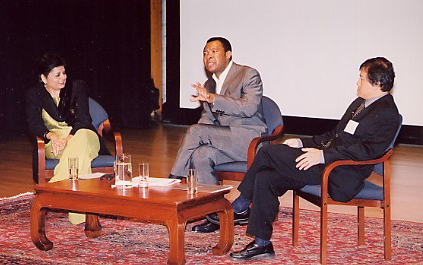
Okwui Enwezor:
Well, again it depends on the space and I think as you mentioned
with Documenta, I fully believed from the very beginning that
Documenta ought not to be a museum even though everybody christened
it the “museum of one hundred days.” I think it is
a space of a different kind of experimentation and I don’t
think it is really that possible to be subversive? simply because
they will just hire the next person! So everybody just has to
do their thing. And I think that the work I did for me, really,
follows in the long tradition of what Documenta has been and I’ve
tried to respond back to Documenta historically. I’ve tried
to do that by attempting to be a good student of Documenta’s
history, looking at its historical speciality, looking at the
way in which it was founded on the basis of a national reconstruction
or reconstitution. What to do with that? I think these are really
clear issues in Documenta and I began by studying them. You mention
Catherine David, but let me just simply say, I categorically decided
that there are three periods of Documenta. The first period to
my thinking, I called the Arnold Bode years from 1955 to 1968,
because these were the Documentas that were really obsessed with
the historical avant-garde. The second period began with Szeemann
and this is very important because I believe that Szeemann’s
Documenta was really the first time in a large-scale exhibition
of that nature, a temporary exhibition, where the subjectivity
of the curator became feasible. It was no longer just simply an
arrangement of people’s taste, an arrangement of sovereign
judgment. It was the imperative of the curator that was in full
display and that’s what made it such a seminal exhibition.
Consequently, I think from Szeemann to Catherine David, I believe
that this period between Documenta V to X really represents a
second period. In as much as I see clear intellectual outlines
between my project and Catherine David’s, I see also a point
of departure that in a sense I think Documenta XI is really the
third period because finally post-1997, one could say that the
very notion of globalization had come to a space of visibility
in which it was no longer something that one could simply call
a theme. It had some very, very serious contemporary repercussions
and so for us, how do we really think about some of these transitions,
or this world of permanent transition? This is the way I think
of the contemporary that the contemporary is a world of permanent
transition and so how do we come to terms with that? In a sense,
many people will say that Documenta XI was very documentary. Whether
it was or not is a different issue. One of its key questions was
about the social life of the world and how communities of ideas
and practices in different places are formed and what do we do
with that? This was our challenge. So we decided that Documenta
could begin by being extraterritorial in order to engage and confront
its own limits and this is, for me, one way I can begin to talk
about the contemporary. That it is this world of permanent transitions,
however large, that we want to say is a civilizational one. I
don’t believe it is.
Apinan Poshyananda:
I think there is this institutional burden that is always going
to be with the curators, especially those who work at various
institutions when they do curatorship independently. I think in
Asia and the Pacific, these so-called triennales or biennales
have a young history but already they have a burden within those
particular decades, I mean in the past ten years. As you know
there have been an emergence, explosions of so many biennales
in Asia. We ask how do they define contemporary art in that region
in order to give it a counter-balance to what’s been happening
in the west, in Europe and America? By inventing these cultural
spaces, they actually have their own adventures, inventions, as
well as restrictions. I’m sure we’ll talk about censorship
and self-censorship later on, but everywhere there are certain
amounts of restrictions, wherever you are, in China, Korea or
Thailand. I think the audience is so important? the specificity
of the place and the locale. You bring certain artists from within
the region or outside of Asia to show to whom? To show to certain
artists, to a certain audience who we know that in some places
have different agendas. The variety is so great in terms of expectation
and novelty, innovation. I was able to work with the Queensland
APT Gallery Asia Pacific Triennale for several of their triennales.
On the second APT, which was in 1996 in Australia, I was invited
to do the Australian section so they were giving this a new slant.
This Thai curator could come in and look at Aussie art from a
different angle, which was an amazing experience. I learned so
much. Destiny Deacon was one person who I admired for her ability
to create art. I visited her in Melbourne in her studio, at her
house, and we had a long conversation and I thought wouldn’t
it be nice to bring her sitting room to Brisbane to show it as
a part of APT and we did that. In Sao Paulo, when I organized
the Asian !
section in 1998, we had to consider the Brazilian audience.
Vishakha Desai:
Let me just stop you there. Does that mean that you always think
about what will play well in the audience and not actually give
a full voice to the range of expressions that might exist in contemporary
Asia because you are constantly, one might argue, playing with
what would play well in a particular community?
Apinan Poshyananda:
You have to consider at a certain level?it depends on the budget
also?you can’t do everything, you know! They tell you, “Sorry
Apinan, congratulations?you do this section but we only have this
amount of money but do it well.” Now we come to smaller
shows and I like to do smaller shows and individual artists as
well. The Japan Foundation has been great in promoting art, just
to move on from Australia to Japan a little bit. They’ve
created many international shows within Asia and without. They
had this policy, you know, especially in the 1980s, of sending
Japanese artists to South-East Asia and literally selecting without
consulting. I felt there should be a counter-balance there. They
didn’t like that, of course, but things change. They actually
changed in the sense that they work more with South-East Asian
curators to create an arena where ideas could be exchanged. I
was pushing it a little bit further in terms of small !
exhibitions. I thought why not invite some really well-known Japanese
artists to Bangkok, individual ones. I started with Nobuyoshi
Araki and that was bad news for the Japan Foundation. Luckily,
Araki came and we had a really big show and he created a new series
of works in Bangkok. Then we invited Yasumasa Morimura, who spoke
on the last night of the show, but this time it was backed by
the Japan Foundation, which was great. So after Araki, the following
year I did Yasumasa Morimura in Bangkok and Morimura was so kind
to come over. He showed many works as well as did the performance
in Thailand. Not only that, he invited artists for individual
shows from without Asia.
Vishakha Desai:
I think partly what you’re talking about is that the role
of various different arenas in which artists get seen and art
gets seen and all of it is fodder for looking at globalization
as a phenomenon where often people have import/export model in
which things come from that part of the world to what we call
the centres of contemporary art. I know, Okwui, you’ve thought
a little bit about this notion of centres, imagined or real, and
I wonder if both of you who’ve travelled, and you’ve
travelled because of the Documenta platforms to India and to other
parts, if you would talk a little bit about the energy of contemporary
art centres that are outside of the Euro-American axis, and your
sense of what is going on there and how does that play out when
you come back to a place like New York.
Okwui Enwezor:
Well, just to pick up a little bit from what Apinan said about
biennales, triennales, their proliferation. I happen to be one
of those people who really think that it is great that there are
so many biennales and triennales. I have no problem that there
are so many of them simply because one has to understand the circumstances
that made them possible. For many places outside of Europe and
North America, these proliferations must be understood in relation
to the ongoing questions of modernization in many of those places.
I think that these are powerful contexts within which some of
these biennales are being formed. I’ve traveled to many
of them from Fukuoka to Dakar to Cairo, of course, Johannesburg,
and so on. I think that what’s interesting in all these
questions is not only just simply that the exhibitions were great,
they also offered moments where people could really begin to think
about art being produced within these regions. They could begin
to write about them, speak about them in intelligent ways. They
could begin to produce ideas around them. I think it’s not
so much that one makes an exhibition, of course people always
make exhibitions, but they provide opportunities for other activities
around art. It creates contexts for artists to be aware of each
other, aware of what’s happening elsewhere and spurs on
new conversations and so on. So even though some of these biennales
may ultimately not be as good as we would wish for them to be,
they also do provide very serious services and questions that
linger on in places where they have been done. In relation to
the ideas of centres, I truly believe it’s complete nonsense
to talk about a centre or centres because there really isn’t
such a thing. Maybe ten, fifteen, twenty years ago, one could
talk about a centre. Let me just say very briefly, in the place
I come from, Nigeria, 1986 was a year of incredible catastrophe.
Catastrophe came in the guise of the Structural Adjustment Programme
which the government signed. I’ll tell you, between 1986
and now, ninety percent of active producing intellectuals have
left the country. Now that’s a disaster, right? I think
they are spread all over the place. What is happening today is
there’s a kind of understanding in which people do not want
to see themselves nudged into the idea of a centre. Going to India
was very instructive for us because it suddenly showed the distance
between Kassel and the rest of the world. Kassel became that much
more isolated. That much more disengaged. In a sense, because
the Indians had this uncanny way of converting everything into
an Indian problem, particularly a problem that they had already
dealt with twenty years ago. They said to us, “you guys
are coming here to talk about it now.” But it was very interesting
to be confronted with the vitality of ideas that were being produced.
We were there for five days. Of course at the end of each day,
we would run out of time!
because it was no longer possible to continue a conversation.
We always had to go outside to continue. This is particularly
interesting because the idea I learned much more clearly was the
idea of the artist intellectual. The model could be really from
the few Indian artists I met in the audience because of their
worldliness, because of their breadth of their ideas and knowledge.
This was particularly good for Documenta. As the volumes from
the different platforms come out, it begins to really say clearly
that the very question of talking about centres is no longer for
me the way that is most productive to work, but really how to
work on a multi-lateral transcultural basis.
Vishakha Desai:
We’re going to move to a different question and then we’ll
open it up to all of you in the audience. I want to actually have
you talk a little bit about art itself. What kind of work really
excites you both, that interests you? The kind of art you really
like to look at. And, if you were to project out five-ten years,
especially in light of what the world has gone through in the
last year since September 11th, what do you think the world of
contemporary art is going to be like when we move out, especially
from the perspective of non-Euro-American contemporary art? The
first part I’d love for you to talk a little bit about the
kind of stuff you like to look at and what it is about that kind
of work.
Apinan Poshyananda:
I like to look at artists…because they make art. You know
a lot of the time I have to look at the art I don’t like
because that’s the profession of curators. You don’t
just look at the art you like. You really have to look at the
art you don’t like as well, and a lot of it. You have to
ask yourself why you don’t like it. Because otherwise, everybody’s
prejudiced. But it’s to the point where, because we do so
many shows and so many audiences, it’s very reciprocal at
different places. Sometimes you have to?one example, I just did
the Irish Biennale earlier this year in Limerick. And in the end,
we showed seventy artists. A lot of the northern Irish, from Northern
Ireland, as well as from the Republic but juxtaposed with Asian
artists as well as European artists. Part of the deal was that
I had to look at a lot of Irish art. You have to be objective
to a certain extent, in the end when you cut the pile you have
to decide.
go
back to top
|