CONTENTS
Summary:
The Rise of Asian Contemporary Art in New York
Preface
by Vishakha N. Desai
1.
Introduction
1.1
Background: Cultural Shifts in the United States
2.
Museums and Non-Profit Organizations
2.1
Asian Artists in Exhibition Programs
2.2
Exhibitions of Significance
2.3
A Case Study: The Whitney Biennial
3.
Galleries
3.1
Asian Artists in Galleries
3.2.
Asian Contemporary Galleries
4.
Auction Houses
4.1
Asian Artists in Auctions
4.2
Top 5 Artists in Sales: Top 10 Highest Recorded Sales of Work
Appendix
1: The Whitney Biennial in Detail
Appendix
2: Asian American Exhibitions: A National Perspective
Summary: The Rise of Asian Contemporary
Art in New York
Across
the three areas addressed in this report that includes museums and
non-profit organizations, galleries and auction houses, we have
found a marked increase in the visibility of Asian and Asian American
artists over the last decade from 1992 through 2002.
In
museums and non-profit organizations, we recorded a sharp increase
of 78% in the number of Asian and Asian American artists included
in exhibitions from 1992 to 2002. This is also reflected in the
number of institutions exhibiting Asian and Asian American artists
which has risen 30% over the last decade. The Whitney Biennial was
used as a case study to chronicle this trend, revealing an initial
increase in representation of Asian and Asian American artists in
1993 with a steady increase of Asian artists, evident in the most
recent exhibition in 2002.
Galleries
in New York have also been steadily expanding the number of Asian
and Asian American artists in exhibitions. This growth is best documented
in a comparative annual calculation between 1992 and 2001. In 1992,
238 Asian artists exhibited in galleries, and 993 artists exhibited
in 2001. Another significant development in this sector has been
the establishment of galleries that exclusively focus on Asian contemporary
art.
Sales
at auction houses have been the slowest to respond, with most activity
recorded from 1997 onwards. Some of this lapse can be accounted
by the secondary market, as it takes more time for the works to
be sold in this forum after gallery exhibitions. In spite of this,
there has been an increase in Asian modern and contemporary sales,
with most of the volume dominated by South Asian art. Yet the top
five artists regularly recorded in sales are Japanese, suggesting
that they as individual artists are well recognized in the contemporary
art field. The top ten highest recorded sales of works are consistent
with this, showing mainly Japanese artists but also with the inclusion
of Korean and South Asian artists.
Preface
Asia
Society is pleased to present Asian Contemporary Art in New York:
The Last Decade 1992-2002, A preliminary study of contemporary art
trends to coincide with the inaugural Asian Contemporary Art Week
(November 5-10). The findings of this report indicate that Asian
and Asian American artists have benefited from increased exposure
and interest across three areas: museums, galleries and auction
houses.
Over
the last ten years, Asia Society has played a leading role in fostering
this interest. One of our first initiatives was to conduct a symposium
in 1992 that included curators from Asia and the United States.
Ten years later, we have seen much change, evident in the recognition
of Asian and Asian American artists. In many ways, Asian Contemporary
Art Week?a combined effort of museums, galleries, curators and scholars?signals
a cultural shift, that such a project would not have been possible
a decade ago.
Asia
Society is a founding member of the Asian Contemporary Art Consortium
(ACAC), the organizers of Asian Contemporary Art Week. This report
provides the foundation for an assessment of the past, while also
signaling future developments.
Vishakha
N. Desai
Senior
Vice President and
Director
of the Museum
Asia
Society
1.
Introduction
The
rationale for undertaking this report was based on the observation
that there has been a recent rise in interest in Asian contemporary
art. Although there is no published evidence to date, there can
be no doubt that Asian and Asian American artists have gained greater
recognition for their work. This report is intended as a preliminary
study toward exploring the development of this trend by providing
some statistical evidence. To gain a sense of these changes over
the last decade, since this is principally the period that we find
a sharp and identifiable interest, this report looks at three main
areas that could be said to define the parameters of the art world:
museums and the non-profit sector, private galleries, and sales
at auction houses. It should be acknowledged that exhibitions of
Asian and Asian American art have also occurred outside of New York,
particularly on the West Coast, but the focus of this study is on
New York. The findings in this report are an attempt to chronicle
this emerging field of Asian and Asian American contemporary art.
1.1
Background: Cultural Shifts in the United States
Over
the last decade there has been an enormous increase in the visibility
and representation of Asian American and Asian artists. This increased
awareness coincided with a broader cultural recognition of artists
of color in the 1990s, evident in artists’ representation
at museums and galleries and well documented in exhibitions such
as The Decade Show (1990) and the 1993 Whitney Biennial. Although
both exhibitions comprised a survey format with the heavy inclusion
of Asian American artists in particular, other exhibitions such
as Asia/America(1994) focused on the specificity of the Asian American
experience. These large-scale museum shows served as platforms for
Asian American artists, their inclusion the culmination of two decades
of agitation through the Asian American social movement begun in
the 1970s. The establishment of advocacy organizations such as the
Asian American Arts Alliance, founded in 1974, and the Asian American
Arts Center in 1983 consolidated these advances, while artist groups
such as Epoxy or Godzilla provided further impetus for Asian American
artists. In general, the recognition of Asian American artists in
the United States can be identified with developments in the early
1990s while a consideration of Asian artists occurred later in the
decade.
2.
Museums and Non-Profit Organizations
2.1
Asian Artists in Exhibition Programs
The
shift in curatorial interest away from the appraisal of traditional
Asian art toward an interest in modern and contemporary art is evident
in museum programs such as the large-scale initiatives undertaken
by the Guggenheim Museum. Exhibitions such as A Century in Crisis:
Modernity and Tradition in the Art of Twentieth Century China(1998),
an exhibition that assessed modern art from China, and Japanese
Art After 1945: Scream Against the Sky (1994) that explored modern
and contemporary Japanese art were significant attempts to re-evaluate
Asian art from a contemporary perspective. These exhibitions based
on a single-nation focus reflected an interest in China and Japan,
countries that have historically dominated a consideration of Asian
art in the United States. Indeed, this interest in China and Japan
is reflected across the three areas of study in this report, with
greater numbers of artists from both countries represented in museums
and galleries as well as at auction sales.
These
two Guggenheim exhibitions no doubt had a broader impact on the
recognition of modern and contemporary Asian art, but the focus
of this section is not so much on an assessment of national focus
exhibitions but rather an account of the numbers of Asian and Asian
American artists in exhibition programs. The graphs below are a
gauge of the levels of inclusion of Asian and Asian American artists
over the past decade. The purpose of these diagrams is to identify
some of the main institutions that have played a leading role in
showing Asian and Asian American artists, including Artists’s
Museum New York Center, Asia Society Museum, Grey Art Gallery, International
Center of Photography, Lower East Side Tenement Museum, Museum of
Holography, New Museum of Contemporary Art, Visual Arts Museum and
Whitney Museum of American Art. Table 1 chronicles the increase
in numbers of museums and non-profit galleries showing Asian and
Asian American artists, as well as the actual number of artists
included in exhibition programs.
Table 1 [1]
| Representation
of Asian and Asian American Artists – 1992 vs. 2002 |
|
|
Number
of Institutions Exhibiting
Asian
Artists |
Number
of Asian Artists Exhibited |
|
1992 |
28 |
37 |
|
2002 |
40 |
170 |
|
|
30%
increase |
78%
increase |
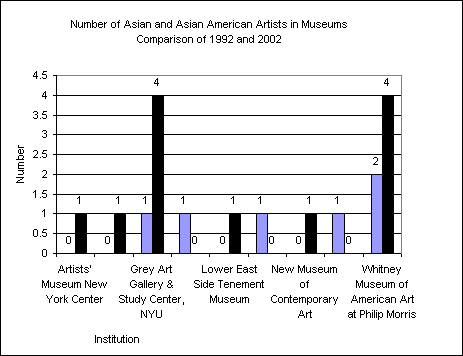
Graph
1 continues the comparative analysis between the years 1992 and
2002 by comparing the number of Asian and Asian American artists
in specific institutions. A clear increase can be seen most overtly
in the programs at Grey Art Gallery and Whitney Museum at Philip
Morris.
Graph
1
2.2
Exhibitions of Significance
One
of the most clearly identifiable indicators of trends is the exhibition.
As already noted, Asian and Asian American artists have been included
in more exhibitions in museums and non-profit galleries than ever
before. In order to gain a sense of the curatorial interest in this
subject, Table 2 provides a timeline of exhibitions of note that
have contributed to the scholarship of this field. These are exhibitions
that have exclusively focused on Asian and Asian American artists
although there have also been a number of curated exhibitions that
were not exclusively Asian and Asian American. Asian art exhibitions,
specifically group-curated exhibitions, have a tendency to be organized
according to a national focus such as China, Japan or Korea. This
is by no means an exhaustive list but does offer some insights into
the thematics of these exhibitions and key artists over the last
decade.
Table
2 Selected Exhibitions
| Year |
Group Exhibition |
Solo Exhibition |
| 2002 |
Femininity
in Contemporary Asian Art: If The Shoe Fits and Vernal Visions,
Curator: Patricia Eichenbaum Karetzky, Lehman College
Art Gallery
|
Lee Bul: Live Forever,
Curator: Clara Kim,
New Museum of Contemporary Art
China Refigured: The Art of Ah Xian, Curator: Melissa Chiu,
Asia Society |
| 2001 |
Translated
Acts: Performance and Body Art From East Asia 1990-2001,
Curator: Yu Yeon Kim,
Queens Museum of Art
Conversations
with Traditions: Nilima Sheikh and Shahzia Sikander,
Curator: Vishakha Desai,
Asia Society |
Do-Ho Suh:Some/One,
Curator: Shamim N. Momin,
Whitney Museum of American Art
at Philip Morris
Yes Yoko Ono,
Curator: Alexandra Munroe,
Japan Society
Hiroshi Sugimoto: Portraits,
Guggenheim Museum Soho |
| 1999 |
Contemporary
Chinese Art and the Literature Tradition,
Curator: Patricia Eichenbaum Karetzky, Lehman College
Art Gallery |
Empty Dream: Mariko Mori,
Curator: Charlotta Kotik,
Brooklyn Museum of Art |
| 1998 |
Inside Out: New Chinese Art,
Curator: Gao Minglu,
Asia Society
|
Tomie Arai: Double Happiness,
Curator: Lydia Yee,
Bronx Museum
Maya Lin: Topologies,
Grey Art Gallery
Sweet Oblivion: The Urban Landscape of Martin Wong,
Organizer: Dan Cameron,
New Museum |
| 1997 |
Asian
Traditions/Modern Expressions: Asian American Artists and
Abstraction 1945-1970, Curator: Jeffrey Wechsler,
Jane Voorhees Zimmerli Art Museum
Against
the Tide: Chinese Women Artists, Curator: Lydia Yee,
Bronx Museum
Project:
Bul Lee & Chie Matsui,
Curator: Barbara London,
Museum of Modern Art
Tracing
Taiwan: Contemporary Works on Paper,
Curator: Alice Yang,
The Drawing Center |
|
| 1996
|
Sites
of Chinatown,
Curator: Lydia Yee,
Museum of Chinese in the Americas
Traditions/Tensions:
Contemporary Art in Asia,
Curator: Apinan Poshyananda,
Asia Society |
Zhang Hongtu: Material Mao,
Curator: Lydia Yee,
Bronx Museum |
| 1995 |
(dis)Oriented:
Shifting Identities of Asian Women in America,
Curator: Margo Machida,
Henry St Settlement Abrons Arts Center and Steinbaum
Krauss Gallery |
|
| 1994 |
Asia/
America: Identities in Contemporary Asian American Art,
Curator: Margo Machida,
Asia Society
Japanese
Art After 1945: Scream Against the Sky, Curator: Alexandra Munroe, Guggenheim Museum |
Xu Bing: Recent Work, Curator: Lydia Yee, Bronx Museum
Bing
Lee,
East West Cultural Studies |
| 1993 |
Across
the Pacific: Contemporary Korean and Korean American Art, The Queens Museum of Art
We
are the Universe,
Haenah-Kent Gallery
The Curio Shop,
Organizer: Godzilla,
Artists Space |
Yin/Yang/Good/Bad/Black/White/Us/Them: An Installation
by Albert Chong,
Curator; Lydia Yee,
Bronx Museum
On Kawara,
Dia Center for the Arts
|
2.3
A Case Study: The Whitney Biennial
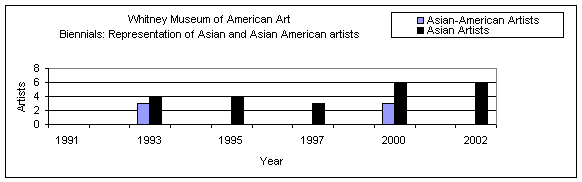
The
Whitney Biennial is considered one of the premier surveys of American
art. Since it is one of the long-standing periodical exhibitions
of contemporary art, one could argue that its history can be used
as an indicator for trends in the visual arts. The 1993 Biennial
marked a significant inclusion of Asian and Asian American artists
following their total exclusion in the previous exhibition in 1991.
During the last decade we can also identify a fall in the inclusion
of Asian American artists and a rise of Asian artists. A complete
breakdown of individual artists can be found in Appendix 1.
Graph
2
3.
Galleries
3.1
Asian Artists in Galleries
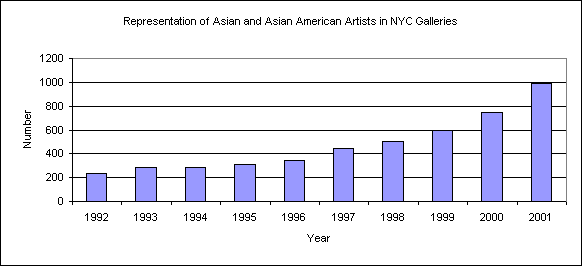
The
representation of Asian and Asian American artists in New York galleries
has grown exponentially. As evident below in Graph 3, the number
of Asian and Asian American artists was calculated at 238 in 1992
compared to 993 in 2001. The shift marks a gradual rise of representation
over the last ten years. Galleries such as Max Protetch, Jack Tilton
and Deitch Projects should be noted as taking the lead in exhibiting
a number of Chinese artists in the mid-1990s. From limited visibility
to an identifiable cultural shift, there is also current evidence
of the inclusion of Asian artists in some of New York’s most
high profile galleries. Some examples include:
Deitch
Projects shows Su-en Wong, Ravinder Reddy, Mariko Mori, Noritoshi
Hirakawa and Momoyo Torimitsu.
Luhring
Augustine shows Chinese artist Zhang Huan as well as Japanese artists
Tatsuo Miyajima, Nobuyoshi Araki, Yasumasa Morimura.
Barbara
Gladstone shows Paris-based Chinese artist Huang Yong Ping.
Lehmann
Maupin shows Korean artist Do-Ho Suh.
Graph3
3.2
Asian Contemporary Galleries
In
addition to the actual rise in number of Asian and Asian American
artists represented by galleries, we have also seen the establishment
of galleries that focus exclusively on Asian contemporary art. It
is interesting to note that the majority of these galleries have
a specific focus on South Asian, Vietnamese and Chinese art. Another
development is the evolution of galleries that once focused exclusively
on traditional art toward the inclusion of contemporary art. Notable
amongst these galleries are China 2000, established in 1980 and
Kaikodo established in 1996.
Table
3:
Asian Contemporary Art Galleries
| Year |
Gallery |
Focus |
|
1987 |
Ethan Cohen |
Chinese |
|
1993 |
Art Projects International |
Asian |
|
1994 |
Bose Pacia Modern |
South Asian |
|
1998 |
Talwar Gallery |
South Asian |
|
1999 |
Chambers Fine Art |
Chinese |
|
2001 |
Gallery Vietnam
Plum Blossoms |
Vietnamese
Asian |
| 2002 |
Goedhuis Contemporary
Gallery Arts India |
Chinese
South Asian |
4.
Auction Houses
4.1
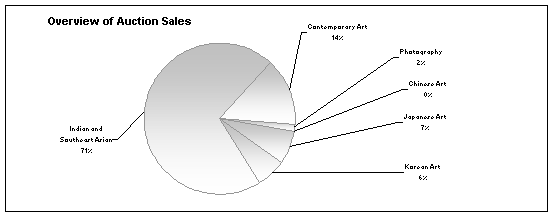
Asian Artists in Auction Sales
The
main auctions of Asian contemporary art have been held by Christie’s,
Phillips and Sotheby’s. The infrastructure of auction houses
dictates in some ways the method of gathering information about
Asian contemporary art since the sales are divided into Chinese
art, Japanese art, Korean art, Indian and Southeast Asian art, contemporary
art, and photography (which has been included in the assessment
since some of the most prominent Asian artists practice in this
medium). High sales of Chinese contemporary art have been recorded
over the past year, but these have been held in Hong Kong with the
other Asian sales rather than in New York. From the findings in
Graph 4, Indian and Southeast Asian works have been subject to the
most activity at auctions in New York.
Graph
4
4.2 Top 5 Artists
The
list of five artists below records the artist’s names who
were found with greatest frequency in auction reports. All of the
artists have appeared primarily in the Contemporary, Post-War, and/or
Photography sales. Interestingly, these artists are all Japanese
reflecting to some extent the dominance of Japanese artists in assessments
of Asian contemporary art in New York.
Yayoi
Kusama (b. 1929)
Mariko
Mori (b. 1967)
Yasumasa
Morimura (b. 1951)
Isamu
Noguchi (1904-1989)
Hiroshi
Sugimoto (b. 1948)
Top
10 Highest Recorded Sales of Works
The
following list of top ten sales of works by Asian artists is calculated
on the actual and estimated sale price of the art work. Once again
this list is dominated by Japanese artists but includes Korean and
South Asian artists. Although this finding is consistent with the
top five list of artists as Japanese, it does conflict with the
records of sales indicated in Graph 4, which shows that the greatest
number of auctions are for South Asian art. One explanation for
this is that a number of the works that received the highest prices
were in the contemporary sales rather than exclusively Asian sales.
This is best illustrated in the top three works listed below that
were included in contemporary sales at Sotheby’s and Christie’s.
1.Isamu
Noguchi (1904-1989)
Cronos,
1962
Bronze,
85 x 30 x 24 inches (215 x 76 x 60 cm)
Sotheby’s
Contemporary, November 2000
Estimate:
$600,000 – 800,000
Actual:
$580,000
2.
On Kawara (b. 1933)
Today
(May 1-7, 1971), series no. 23-29
Liquitex,
eight cardboard boxes, and newspaper, 10 x 13 inches (25 x 33 cm)
Christie’s
Contemporary, June 1998
Estimate:
$200,000 – 300,000
Actual:
$520,000
3.
Takashi Murakami (b. 1962)
Hiropon
Oil,
acrylic, fiberglass, 88 x 41 x 48 inches (223 x 104 x 122 cm)
Christie’s
Contemporary, May 2002
Estimate:
$80,000 – 120,000
Actual:
$380,000
4.
Park Soo-Keun (1914-1965)
Mother
Pounding Grain, 1964
Oil
on board
Sotheby’s
Korean Works of Art, September 1997
Estimate:
$350,000 – 400,000
5.
Tyeb Mehta (b. 1925)
Celebration,
1995
Acrylic
on canvas, triptych 94.5 x 202.5 inches (240 x 510 cm)
Christie’s
Indian and Southeast Asian Art, September 2002
Estimate:
$180,000 – 200,000
6.
Mariko Mori (b. 1967)
Red
Light, 1994
Set
of three photographs
Phillips
Contemporary, May 2002
Estimate:
$80,000 – 120,000
Actual:
$140,000
7.
Yayoi Kusama (b. 1929)
No.
Red. Q, 1960
Oil
painting, 41 x 64 inches (105 x 162 cm)
Sotheby’s
Contemporary, November 1998
Estimate:
$60,000 – 80,000
Actual:
$70,000
8.
Maqbool Fida Husain (b. 1915)
Mahabali,
1964
Oil
on canvas, 90 x 65 inches (228.6 x 165 cm.)
Christie’s
Indian and Southeast Asian Art, September 2002
Estimate:
$60,000 – 80,000
9.
Shusuku Arakawa (b. 1936)
The
Call of Continuity, 1977-78
Oil,
graphite and color felt-tip pens on canvas
Christie’s
Contemporary Art, Part II May 1994
Estimate:
$50,000 – 70,000
10.
Hiroshi Sugimoto (b. 1948)
World
Trade Center
Gelatin
silver print, 24 x 20 inches (61 x 50 cm)
Phillips
Contemporary/Photography, April 2002
Estimate:
$20,000 – 30,000
Actual:
$35,000
Appendix
1: The Whitney Biennial in Detail
Whitney
Museum of American Art, New York
1991
Biennial
Curated
by Richard Armstrong, John G. Hanhardt, Richard Marshall, Lisa Phillips
No
Asian or Asian American artists included
1993
Biennial
Curated
by Elisabeth Sussmann, Thelma Golden, John G. Hanhardt, Lisa Phillips
Included
3 Asian American artists and 4 Asian artists.
-
Christine Chang (b. 1963 Seoul, Korea; lives in New York)
-
Shu Lea Cheang (b. 1954 Taiwan; lives in New York)
-
Byron Kim (b. 1961 La Jolla, CA; lives in New York)
-
Simon Leung (b. 1964 Hong Kong; lives in New York)
-
Trinh T. Minh-ha (b. 1952 Hanoi; lives in Berkeley, CA)
-
Bruce Yonemoto (b. 1949 San Jose, CA), Norman Yonemoto (b. 1946
Chicago), and Timothy Martin
1995
Biennial
Curated
by Klaus Kertess with John Ashberry, Gerald M. Edelman, John G.
Hanhardt, and Lynne Tillman
Included
4 Asian artists.
-
Hima B. (b. 1968 Calcutta; lives in San Francisco)
-
Shu Lea Cheang (b. 1954 Taiwan; lives in New York)
-
Toba Khedoori (b. 1964 Sydney; lives in Los Angeles)
-
Rirkrit Tiravanija (b. Buenos Aires; lives in New York)
1997
Biennial
Curated
by Lisa Phillips and Louise Neri
Included
3 Asian artists.
-
Lara Lee (b. 1966 São Paulo; lives in New York)
-
Shahzia Sikander (b. Lahore, Pakistan; lives in Houston, TX)
-
Shashwati Talukdor (b. Dehra Dun, India; lives in Philadelphia)
2000
Biennial
Curated
by Maxwell L. Anderson, Michael Auping, Valerie Cassel, Hugh M.
Davies, Jane Farver, Andrea Miller-Keller, Lawrence R. Rinder
Included
3 Asian American artists and 6 Asian artists.
-
Rina Banerjee (b. 1963 Calcutta; lives in New York)
-
Cai Guo-Qiang (b. 1957 Quanzhou City, Fujian Province; lives in
New York)
-
Michael Joo (b. 1966 Ithaca, NY; lives in New York)
-
Shirin Neshat (b. 1957 Qazuin, Iran; lives in New York)
-
Walid Ra’ad (b. 1967 Chbanieh, Lebanon; lives in New York)
-
Al Souza (b. 1944 Plymouth, MA; lives in Houston, TX)
-
Sarah Sze (b. 1969 Boston; lives in New York)
-
Tran, T. Kim-Trang (b. 1966 Saigon; lives in Los Angeles)
-
Yukinori Yanagi (b. 1959 Fukuoka, Japan; lives in New York)
2002
Biennial
Curated
by Lawrence R. Rinder, Chrissie Iles, Christiane Paul, Debra Singer
Included
6 Asian artists.
-
Chan Chao (b. 1966 Kalemyo, Burma; lives in Washington, D.C.)
-
Yun-Fei Ji (b. 1963 Beijing; live in New York)
-
Kim Sooja (b. 1957 Taegu, Korea; live in New York)
-
Walid Ra’ad / The Atlas Group (b. 1967 Chbanieh, Lebanon,
live in New York)
-
Stom Sogo (b. 1975 Osaka, Japan; lives in San Francisco)
-
Zhang Huan (b. 1965 An Yang City, He Nan Province, China; live in
New York)
Appendix
2: Asian American Exhibitions: A National Perspective
By
Margo Machida
In
the 1990s, an unprecedented number of group exhibitions organized
by U.S.-based art museums, arts organizations, and university galleries
have specifically fore-grounded work by Asian American artists,
or juxtaposed contemporary Asian and Asian diasporic artists. Among
them are national and regional survey exhibitions such as Asian
Traditions/Modern Expressions: Asian American Artists and Abstraction
1945 - 1970 (1997); They Painted From Their Hearts: Pioneer Asian
American Artists (1994); and With New Eyes: Toward an Asian American
Art History in the West (1995). Concurrently, there have been exhibitions
focused on specific periods in American history, such as The View
from Within: Japanese American Art from the Internment Camps, 1942-1945
(1992), and Relocations and Revisions: The Japanese-American Internment
Reconsidered (1992)? as well as thematic, ethnic-specific, and sociopolitical
shows. They include ASIA/AMERICA: Identities in Contemporary Asian
American Art (1994), organized by Margo Machida for The Asia Society
Galleries (1994); Across the Pacific: Contemporary Korean and Korean
American Art (1993); Picturing Asia America: Communities, Culture,
Difference (1994); Who’s Afraid of Freedom: Korean American
Artists in California; Memories of Overdevelopment: Philippine Diaspora
in Contemporary Art (1996);Uncommon Traits: Re/Locating Asia (1997-98);
and At Home & Abroad: 20 Contemporary Filipino Artists (1998).
Note:
Other recent group exhibitions such as Shifting Perceptions: Contemporary
L.A. Visions (2000), organized by the Pacific Asia Museum, featured
Los Angeles-based artists of Asian/Pacific heritage but did not
explicitly highlight their ethnicities.
Selected Bibliography:
Site
of Asia Site of Body: Contemporary Asian Women Artists (New York:
The Taipei Gallery, 1998).
At
Home & Abroad: 20 Contemporary Filipino Artists (San Francisco:
Asian Art Museum of San Francisco, 1998).
Asian
Traditions/Modern Expressions: Asian American Artists and Abstraction
1945 - 1970, ed. Jeffrey Wechsler (New York: Harry N. Abrams, Inc.
in association with the Jane Voorhees Zimmerli Art Museum, Rutgers,
The State University of New Jersey, 1997).
Memories
of Overdevelopment: Philippine Diaspora in Contemporary Art (Winnipeg,
Canada and Irvine, California: Plug In Editions and the University
of California, Irvine, Art Gallery, 1997).
Uncommon
Traits: Re/Locating Asia, Parts I - III (Buffalo, New York: CEPA
Gallery, 1997-98). Dates: Part I. September 13 - October 31, 1997;
Part II. December 6, 1997 - January 23, 1998; Part III. February
14 - March 28, 1998.
Who’s
Afraid of Freedom: Korean American Artists in California (Newport
Beach, California: Newport Harbor Art Museum, 1996).
With
New Eyes: Toward an Asian American Art History in the West (San
Francisco: San Francisco State University, 1995).
They
Painted From Their Hearts: Pioneer Asian American Artists (Seattle:
University of Washington Press, 1994).
Picturing
Asia America: Communities, Culture, Difference (Houston, Texas:
Houston Center for Photography, 1994).
ASIA/AMERICA:
Identities in Contemporary Asian American Art (New York: The Asia
Society Galleries and The New Press, 1994).
Across
the Pacific: Contemporary Korean and Korean American Art (New York:
The Queens Museum of Art, 1993).
The
View from Within: Japanese American Art from the Internment Camps,
1942-1945, (Los Angeles: The Japanese American National Museum,
the UCLA Wight Art Gallery, and the UCLA Asian American Studies
Center, 1992).
Relocations
and Revisions: The Japanese-American Internment Reconsidered (Long
Beach, California: Long Beach Museum of Art, 1992).
Shifting
Perceptions: Contemporary L.A. Visions (Pasadena: Pacific Asia Museum,
2000).
Published
on the occasion of Asian Contemporary Art Week (November 5-10, 2002)
Published
by
Asia
Society
725
Park Ave
New
York NY 10021
www.asiasociety.org
Contributors
Melissa
Chiu is Curator, Contemporary Art at Asia Society and Museum
Miwako
Tezuka is a Ph.D. candidate at Columbia University. She was a recipient
of the Luce Foundation Museum Fellow in Asian Art at the Asia Society
and her recent work includes curatorial consultation for The Legacy
Project, NYC.
Linda
Park is a graduate student at The Center for Curatorial Studies,
Bard College and an independent curator/writer living in New York.
--------------------------------------------------------------------------------
[1]
Table 1 and Graph 1: Assessment based on Art in America Guide: Sourcebook
to the U.S Art World published annually.
go
back to top |